Latest bucket · B BucketCase 04170018Published 04/12/2026, 08:06
Open original videoHook Type:Imitation-challenge hook + physical-comedy hook + odd-motion hook
Every Weird Motion Becomes a New Full-Body Imitation Challenge
Original title:+The funniest imitation #challenge #imitation
Channel
Daily Funny.06
Views
32,479,822
Likes
149,536
Comments
46
[Start with a strange but instantly readable motion] + [cut to a performer who claims he can do it too] + [keep forcing the body into different object-like shapes] + [finish on the broadest, funniest visual imitation] = a physical imitation-challenge Shorts formula
This short is not a conventional plot-driven skit. It is a rapid imitation challenge built on one simple engine: show a motion or object state, then have the performer immediately claim he can do it too. The opening uses visually odd reference actions that are easy to understand but slightly ridiculous for a human body to copy. Then the clip cuts to the performer, who does not explain anything and does not slow down. He leans, jumps, crouches, balances, and rolls his body into a series of shapes that echo hoses, steps, exercise balls, and other moving forms. The comedy does not come from one perfect imitation. It comes from relentless escalation. Just as the audience finishes decoding one copycat move, the clip offers another reference and another attempt that is even more absurd. By the end, the challenge has turned the man's body into a kind of all-purpose prop, which is exactly why the reel works as such a fast visual-comedy format.
Market
East Asian imitation-challenge / physical-comedy context
Language type
Light dialogue
Estimated RPM
USD 0.01 - 0.04 per thousand views (imitation challenge / physical-comedy Shorts, conservative estimate)
Emotion curve
CuriosityRule recognitionFirst laugh hitEscalationBigger physical absurdityClean visual payoff
Contact sheet
Contact sheet
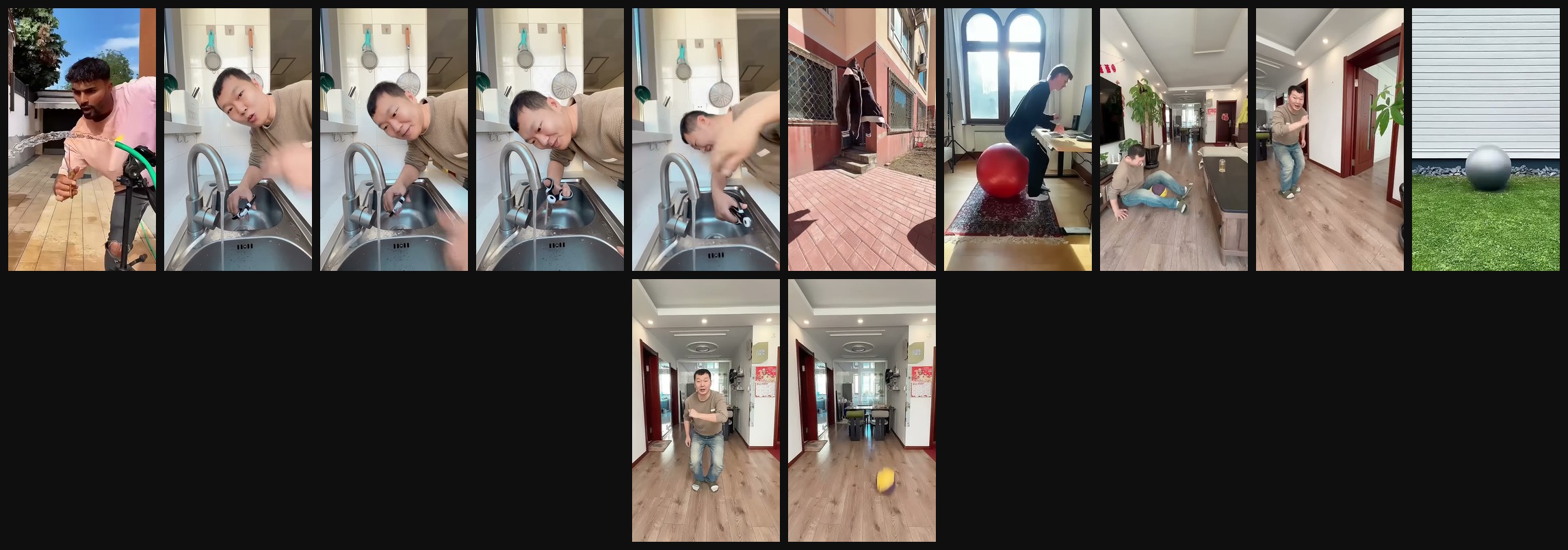
0-3 seconds
0-3s opening hook

The opening action is weird enough to stop the scroll before any explanation is needed.
Once viewers understand the rule that every new motion will be copied, each cut creates built-in anticipation for the next attempt.
The hook works because the format is simple, fast, and visibly ridiculous.
Density
Viral density
Turning points
The first reference action establishes the challenge rule
The performer delivers the first body-copy response
Different spaces and props keep refreshing the imitation type
The exercise-ball and rolling-object beats raise the absurdity
The final movement closes the loop on the imitation concept
Core conflict
The humor comes from the mismatch between the smooth logic of objects or motions and the awkward reality of a human body trying to replicate them.
Ending design
The ending does not need explanation. It only needs one last strong imitation that lets the audience leave remembering the performer as the guy who will try to become anything.
Edit density
Very high. Nearly every new shot introduces a fresh gag, so the clip never gives attention time to drift.
Roles
Roles
The imitator
He is the only stable character in the reel, and his whole job is to turn his body into increasingly silly copies of what he sees.
The reference motions
These provide the audience with the original logic of each gag before the imitation distorts it.
The ball and rolling-object beats
These are the strongest late-stage visuals because they force the human body into especially object-like shapes.
The repeated catchphrase
The line acts as a trigger that tells the viewer the next imitation is about to begin.
Frame-by-frame
Frame-by-frame
00:00 - 00:05
A strange reference motion appears first, and the clip immediately establishes that imitation is the game's only rule.
00:05 - 00:10
The performer starts copying with sink-side and stepping movements, turning body posture into the core joke.
00:10 - 00:17
Indoor props like the exercise ball and table area expand the challenge from simple copying into full physical absurdity.
00:17 - 00:24
The final rolling-object beat closes the reel on its clearest, broadest imitation gag.
Visual language
Visual language
fixed wide framingobject-shape readabilityfast challenge cutsindoor depth for body movement
The framing stays simple because the viewer needs to see the whole body and the whole object logic at once.
Cutting between reference motion and imitation keeps the format instantly readable even when the actions are silly.
The broad spaces matter because the performer needs room to turn his body into the joke.
Scene & props
Scene & props
Scene keywords
Outdoor hose areaStepsKitchen sinkDesk cornerLiving-room hallwayGrass-side ball shot
Prop keywords
HoseSinkStepsRed exercise ballYellow rolling objectCoffee tableHallway floor
BGM
BGM
The sound layer behaves more like a challenge cue than a narrative soundtrack.
Retention comes from the visual copycat structure and escalating body comedy, not from extended dialogue.
Dialogue / text
Dialogue & screen text
00:00 - 00:20 Original: 我也会。
00:00 - 00:20 Translation: I can do that too.
Audience
Audience
Viewers who like fast physical comedy and challenge-based Shorts
People who get hooked by the question of how far a performer will push a visual gag
Shorts users who want a new joke beat every few seconds